Getting ready to advertise on ChatGPT? OpenAI is about to seriously shake up Google's, Meta's, and Bing's dominance of online advertising by introducing direct sponsored-content opportunities inside ChatGPT.
The ability for users to ask questions, research brands, and compare products and services is already pulling organic traffic away from websites - and it will soon affect brand visibility and ad share as well. In June 2026, OpenAI opened the ChatGPT advertising platform to businesses in the UK, and in July it added audiences, new reporting, and expanded its presence in Asia. In this article, we look at what's new, and when we can expect to advertise on ChatGPT in Bulgaria as well.
ChatGPT Ads Manager is now being tested in the UK
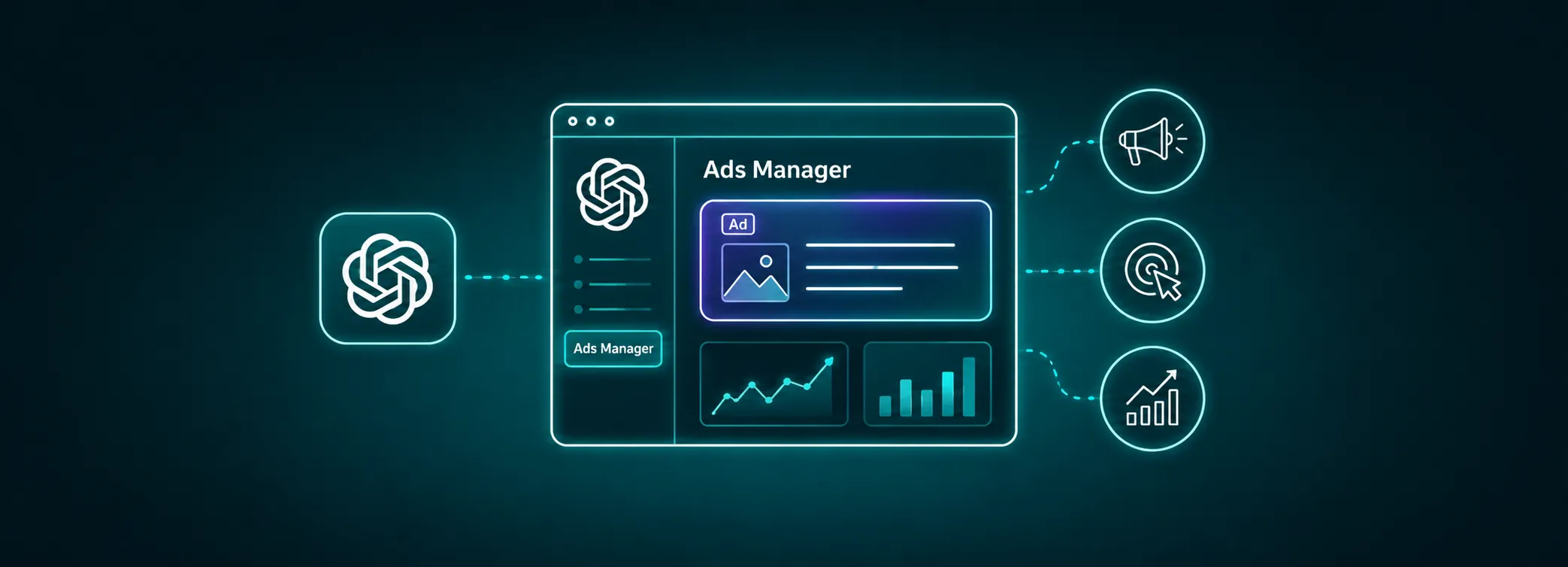
OpenAI is now opening access to ChatGPT Ads Manager Beta for businesses in the UK. The ads manager interface lets users create advertising accounts and start testing campaign management tools. The dashboard currently contains the familiar sections you'd expect from other advertising platforms, giving access to campaigns, management tools, billing, and additional account settings. As with other newly launched advertising platforms in recent years (for example, TikTok's), the developers are borrowing established best practices from Google Ads and Meta Ads.
Our advice for businesses: Don't let a marketing agency or advertising partner create a ChatGPT ad account on your behalf, at least for now. We recommend that you create the account for your own business and then invite an advertising partner with the appropriate permissions.
A note for search advertising agencies: If you work with Google Ads, you're probably used to the convenience of a manager account from which you can manage all of your clients' accounts. That kind of feature isn't yet available in ChatGPT Ads, and for now, managing a client portfolio will mean working within each individual client account you've been added to as a partner.
Access to Ads Manager gives brands and agencies in the UK a chance to understand the interface, workflows, and account structure before the platform sees wider adoption. Search Engine Land has also shared interesting information and early observations after the first prospective advertisers in the country started testing the functionality.
What's new in ChatGPT Ads Manager as of July 2026
Since the news of ChatGPT advertising first broke, OpenAI has been continuously adding features:
- Custom audiences: advertisers can now upload lists of 25,000+ users to target with their ads.
- An "Overview" tab, familiar from other platforms, for monitoring overall account health, recommendations for improving campaigns, and a chart of key metrics.
- Suggested ad variations: ChatGPT can suggest new ad content if it determines your campaign needs broader coverage (similar to the audience or keyword-list expansion suggestions, as well as budget increase and new creative suggestions, you may already be familiar with).
- Presence in Japan and South Korea: campaigns can now target users in these markets.
- Geo-targeting and daily budgets: the ability to target by state/ZIP code (for the US) and choose between a daily or lifetime budget for new campaigns.
- Bulk editing: mass editing of campaigns, ad groups, and ads directly in the interface.
Which markets can you advertise in on ChatGPT
Here is the currently known timeline for ChatGPT advertising availability and expansion by market:
Market | When ChatGPT advertising launched |
|---|---|
US | February 9, 2026 |
Canada, Australia, New Zealand | March 2026 |
UK (first European market) | June 6, 2026 |
Japan, South Korea | June-July 2026 |
Brazil, Mexico | Announced, in the process of rolling out |
How a ChatGPT ad actually looks and works
Now that we've covered the news, it's worth looking at how ChatGPT advertising actually works and what it offers businesses that want to advertise on the platform.
The format. The ad appears as a standalone sponsored result shown below ChatGPT's answer to the user's question. As with standard search advertising, the goal is visual separation and clear labeling as paid content. The ad includes the brand name, logo, a headline, short copy, and a link to the landing page. Important note: the AI's answer remains independent of the ads and cannot be manipulated by advertisers.
The ad auction: how does ChatGPT decide which ad to show?
Here we find a fundamental difference from the Google Ads model. In ChatGPT, there's no bidding on keywords - you bid on context ("context hints"). At the ad group level, you define, in natural language, the topics or situations in which your product or service would be useful to the user. The advertising platform and its algorithm then determine which ad is the best match based on the full context of the conversation with the user, the quality of the landing page, and the ad's headline and copy. Unlike Google Ads, there's no exact match on keywords and phrases.
Important note: context "hints" don't guarantee your ad will show in a specific chat between a user and the platform - just as Google and Meta don't guarantee you an ad position or ad share.
Billing
ChatGPT Ads Manager currently supports two billing models:
- CPM (with a Reach objective) - you pay per 1,000 impressions (ad views). This model suits brand, product, and service awareness campaigns.
- CPC (with a Clicks objective) - you pay per valid click on the ad. OpenAI recommends an initial maximum bid of $3-5 USD per click.
Important note: OpenAI is telling us the same thing Google and Meta have always said - budget isn't the most important factor in whether your ad gets shown. How relevant your ad is to the user's conversation, and whether it's the best match among all the advertisers competing for the same customer, matters just as much.
Reporting
As of now, we know Ads Manager Beta shows impressions, clicks, spend, CTR, average CPC, average CPM, and conversions. To measure actual conversions, advertisers can set up a tracking pixel or add static UTM parameters to landing pages, compatible with standard web traffic and user behavior analytics tools.
Landing page requirements
Landing pages must be published and accessible, and must not block OpenAI's bots (OAI-AdsBot and OAI-SearchBot) - something website development teams should keep in mind right now, regardless of whether they're planning to advertise on ChatGPT.
Important note from DGTalents: Opening your website up to indexing by AI tool bots like ChatGPT's, Claude's, and others can increase the load and number of requests to your site. If your web hosting plan has processing-time limits, your provider may flag increased load and the need to change your current plan. We recommend using a hosting solution where this scenario is already accounted for, so it doesn't require extra costs or a migration to another solution just as your business, ad campaigns, and so on are scaling up. For further consultation, feel free to reach out to our team today.
Privacy and user controls - and why you can't "bribe" ChatGPT into becoming an advocate for your business
In conversations with clients, we're already seeing a misconception take hold: that advertising on ChatGPT will let you influence the platform's answers in favor of your business (and often, to the detriment of competitors). But that's not at all how things work.
OpenAI emphasizes that ads do not influence ChatGPT's answers - the advertising platform and algorithm run on infrastructure separate from the model itself, and advertisers have no way to shape, rank, or alter the answers. This is a principle the company has consistently repeated since the pilot launch of ChatGPT advertising in February 2026.
Here are a few more details that, for now, keep control over advertising firmly in the hands of users:
- Ads only appear to logged-in users on the Free and Go plans. Plus, Pro, Business, Enterprise, and Edu accounts don't see ads at all.
- No ads for users under 18 - if a user indicates they're a minor, or the system predicts this, they won't see ads.
- Users are in control - they can switch to an "Ads-Free" option (with lower message limits) from Settings → Ads controls, or upgrade to a paid plan to remove ads entirely.
- Data stays inside ChatGPT - advertisers receive only aggregated reports (impressions, clicks), not the content of conversations or users' personal information.
- Ads are kept away from sensitive topics - health, mental health, and politics are explicitly excluded from the contexts in which ads can appear, along with many other regulated categories where online advertising is either prohibited or restricted.
Important note from DGTalents: On Google and Meta, you advertise to audiences you have demographic or behavioral data about, and the majority of users on those platforms can be a potential target for your ads. That won't be quite the case on ChatGPT, since a large share of users will already be on paid accounts by the time ads become available, and targeting will be based on conversation context rather than your ideal customer profile.
What to expect - and when - in the EU and Bulgarian market
The UK is the pilot European market where ChatGPT advertising is launching, but we're still a long way from seeing it across the EU and in Bulgaria. Here are some of the factors shaping how ChatGPT Ads Manager develops:
- GDPR requires explicit user consent before an ad can be personalized - unlike the simpler opt-out model used in the US. OpenAI has already updated its EU ads policy, committing to rely on explicit consent rather than "legitimate interest" as the legal basis for processing personal data.
- We know the company isn't treating the EU as a single market, and will roll out ChatGPT advertising country by country.
- Germany and France are expected to follow the UK, but OpenAI hasn't yet announced an official date for entering eurozone markets or Central and Eastern Europe.
What you can do today to prepare for ChatGPT Ads in Bulgaria
You still can't run an ad targeted at a Bulgarian audience on ChatGPT, since the platform doesn't yet support this market. You can test ChatGPT ads if you have customers or sales in the UK, US, Canada, Australia, New Zealand, Japan, or South Korea.
Work on your content optimization (SEO / AIO / GEO)
Important: all the best practices for visibility in standard search engines like Google also apply to your business's visibility in ChatGPT. There are no extra tricks or secret ways to "train" the models into favoring you on AI platforms. Businesses that already appear organically in ChatGPT's answers report better performance from their paid ads once the channel opens up - because the ad reinforces something the user has already seen, rather than interrupting the conversation.
What should you add to your site? Nothing new, beyond:
- clear service descriptions;
- well-structured FAQ sections;
- content that directly answers the questions your customers are asking.
Don't cut Google Ads and Meta Ads out of your advertising strategy
The fact that ChatGPT is launching ads doesn't mean users will stop using Facebook, Instagram, or Google (where we'll also see ads in AI Mode, or in Gemini). For your business, the change might mean a shift of customers toward or away from one platform in favor of another - and the balance will be highly individual, depending on your current ad mix, budget, stage of growth, and willingness to test different digital advertising tools.
A comment from DGTalents Marketing Agency
ChatGPT Ads, like Google Ads, Meta Ads, and TikTok Ads, won't be the right advertising channel for every business. For now, we're advising our clients to keep a strong focus on optimizing their content for search engines, since that's more likely to get them featured in ChatGPT's answers to user questions. It's also important to make sure your website and hosting plan don't create technical obstacles for crawling by ChatGPT's, Claude's, Gemini's, and Google's bots.
As a certified Google Partner with years of experience managing Google Ads and Meta Ads campaigns for the Bulgarian market, we'll be recommending that our clients monitor the space and, as soon as it makes sense, test the new ad formats with our help and quickly assess their impact on the business. All of this will play out amid an even more intense battle for user attention between social networks, AI platforms, and every other channel where businesses sell their products, services, and ideas. And don't forget - Google is rolling out ads in AI Mode too, which makes the race even fiercer.
For more information and a marketing consultation, feel free to contact our team today, or send us a brief for your online project here.
Frequently Asked Questions
Can a Bulgarian company advertise on ChatGPT? Not yet, if the goal is a Bulgarian audience, since ChatGPT Ads isn't available for Bulgaria. If your target audience is in the UK, US, Canada, Australia, New Zealand, Japan, or South Korea, it's technically possible to test a campaign.
What is ChatGPT Ads Manager? OpenAI's platform for creating and managing advertising campaigns on ChatGPT, with sections for campaigns, tools, billing, and settings.
When will ChatGPT Ads reach the European Union? No date has been announced. The UK is the first European market (June 2026), and expansion into eurozone markets depends on compliance with GDPR and other EU regulations.
Do all ChatGPT users see ads? No - ads are only shown to logged-in users on the Free and Go subscription plans. Plus, Pro, Business, Enterprise, and Education users don't see ads.
How can I prepare for ChatGPT Ads right now? By investing in AI SEO/GEO optimization of your website content - clear service descriptions, structured FAQ sections, and expert content that AI models can easily understand and cite.
Do you bid on keywords in ChatGPT Ads, like in Google Ads? No. Instead of keywords, advertisers set "context hints" - descriptions of the conversations and situations in which their product is useful. The system selects the ad based on the full context of the conversation through a relevance-weighted second-price auction, rather than an exact phrase match.
How much does advertising on ChatGPT cost? Both CPM (pay per 1,000 impressions) and CPC (pay per click) models are supported. OpenAI recommends an initial maximum bid of $3-5 USD per click for CPC campaigns.
Do ads influence the answers ChatGPT gives? No. The advertising system runs on infrastructure separate from the model - advertisers have no way to shape, rank, or alter ChatGPT's answers. Ads are always clearly labeled as sponsored and visually separated from the answer.