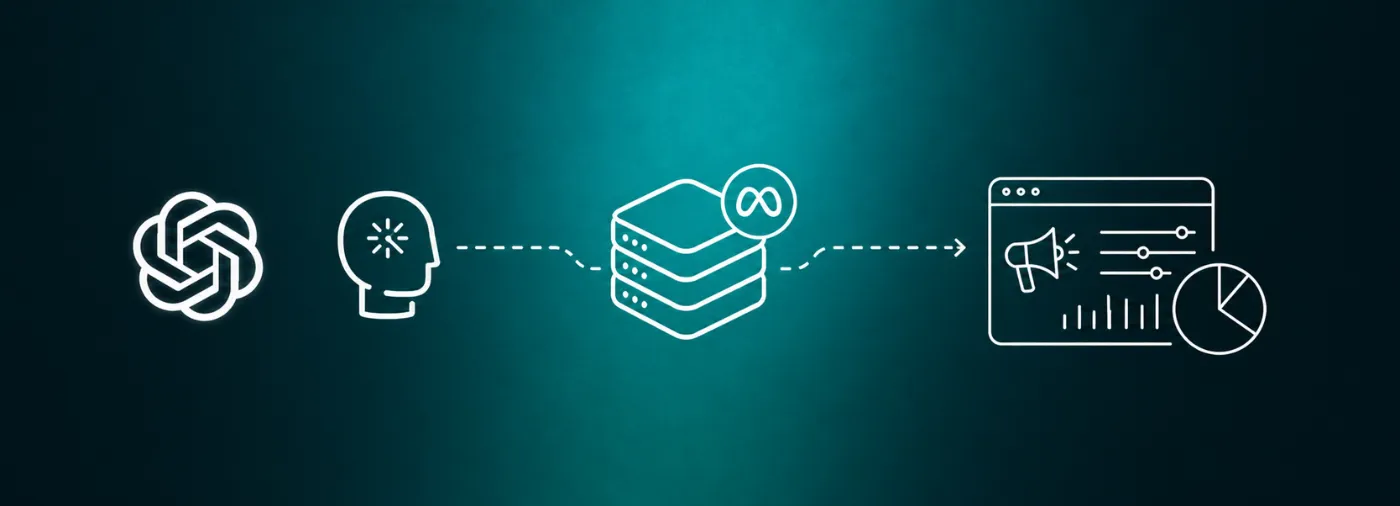
On April 29, 2026, Meta did something few people expected this soon. They launched an official MCP server that connects ad accounts directly to AI assistants like Claude and ChatGPT. For the first time, advertisers can manage campaigns, read reports, and make changes to their accounts simply by speaking in plain, conversational language.
Without opening Ads Manager. Without navigating through menus. Without waiting for a specialist.
What Exactly Is MCP and Why Does It Matter
MCP (Model Context Protocol) is a technical standard that allows AI tools like Claude and ChatGPT to connect directly to external platforms and systems. Once connected, the AI assistant gains access to real data inside the ad account.
Until now, most processes and settings in Meta Ads happened manually through Ads Manager or via the Marketing API. Now, all of this is expected to be possible in plain, conversational language through a chat interface.
What You Can Do with Meta Ads MCP
Meta's official MCP unlocks 29 tools for direct work with ad accounts. In practice, this means:
- Reports and analytics - you can ask questions like "How have my campaigns performed over the last 30 days?" or "Which ads are generating the highest cost per click?" and get an answer within seconds - without logging into Ads Manager, downloading spreadsheets, or comparing data manually.
- Campaign management - you can create new campaigns, edit existing ones, change budgets, and update ad sets directly within a conversation with AI. Something that previously took minutes or hours to configure now happens with a single text command.
- Product catalog management - adding products, creating catalogs, diagnosing feed errors... the kind of tasks that are a favourite headache for many online marketing specialists. 😉
- Signal diagnostics - pixel health checks, conversion quality, event setup, and more.
How to Connect Claude to a Meta Ads Account
The process is surprisingly straightforward and does not require developer involvement or additional validation from Meta's team.
In Claude's settings, you need to add Meta's official MCP URL (mcp.facebook.com/ads) and authorize access to your Meta account through a standard OAuth login. From that point, Claude has direct access to your ad accounts and can read and write data within them.
Important note: To use MCP integrations in Claude, a Pro or Max subscription is required.
End of the Debate: "Meta Bans External AI Tools for Ad Management"
For a long time, a concern circulated in marketing communities that using AI tools to manage Meta ads could lead to account restrictions or bans. That concern is now officially outdated.
With the launch of the official MCP, Meta themselves are opening the door to AI assistants inside ad accounts. This is the legitimate, Meta-approved path to automation - not a workaround, but an officially supported integration.
Which AI Tools Work with Meta Ads MCP
Meta's official MCP works with any AI client that supports the Model Context Protocol standard. At the moment, these include Claude (Anthropic), ChatGPT (OpenAI), Claude Code, and OpenAI Codex.
In addition to Meta's official MCP, there are third-party integrations such as Pipeboard and Ryze AI that offer similar functionality - sometimes with additional options like managing Google Ads and TikTok Ads from a single interface.
What This Changes for Advertisers
For businesses and marketing teams managing Facebook and Instagram ads, this shift is significant for several reasons:
- Time saved. Routine tasks like checking reports, adjusting budgets, and diagnosing campaigns no longer require navigating through Ads Manager. You can get an answer and make a correction in seconds.
- More accessible optimization. Until recently, in-depth analysis of ad accounts required either an experienced specialist or hours of work. Now any marketing manager can ask questions and receive concrete data in real time.
- A new role for marketing specialists. Automation does not replace marketers - it frees up time from routine tasks so they can focus on strategy, creative work, and business decisions.
What Comes Next
Meta launched the integration in open beta, which means further development is on the way. Expanded capabilities, better documentation, and likely integrations with more AI platforms are all expected.
For marketing agencies, freelancers, and in-house marketing teams managing Meta ads for clients, this change enables new ways of working - faster reporting, easier client communication, and more efficient optimization.
This is just the beginning of a broader shift in how marketers interact with advertising platforms. And Meta has given the official starting signal.
A Comment from DGTalents Marketing Agency
We welcome every innovation that allows our team and clients to optimize their work, gain more visibility, and have direct access to settings, adjustments, and performance reporting.
We believe that the development of AI-based solutions that enable faster and more accurate decision-making is nothing but beneficial for every business.
That said, we advise users without experience on Meta's advertising platform, and without previously run ad campaigns, not to rely solely on AI assistants for independent campaign execution. The reason: even if you can quickly and easily set up or adjust a campaign through AI, not knowing all the tools, categories, and specifics of Meta Ads can lead to suboptimal execution and poor use of your advertising budget.
Stay tuned for our first data from test campaigns run and optimized with the help of AI assistants, along with a comparison to results from campaigns we manage the "classic" way.
Contact our team for more information and consultation on Meta advertising.