We are sharing some genuinely useful insights on one of the topics that's on the minds of businesses, marketers and content creators the most in 2026. You've probably already noticed that many of them are competing for the attention of AI tools and chatbots, and that being among the cited results often turns out to be a serious challenge.
More than a year ago, we already discussed how Google's AI Mode - and now the rest of the popular AI tools too - are "eating into" organic traffic to websites, since users get answers to their questions before they ever visit a single web page, with no need to compare all the ranked results themselves. If your business isn't present in the cited answers, chances are the user will never visit your business, product or service page at all.
So if you're wondering how to rank among those answers, here's some very recent data on what the most popular AI tools read in order to answer user searches - data that can help you define your own GEO/AEO strategy.
The main source of this data is Muck Rack, which analyzed more than 25 million links across the three leading AI models, supplemented with observations from marketing agency DGTalents specifically for the Bulgarian market.
The analysis covers a wide range of user searches and specific questions, with sources broken down into several main categories (owned and third-party channels, media, social networks, informational websites and so on).
Which sources do ChatGPT, Claude and Gemini read
Overview: AI doesn't pull data from paid and advertising content
Sponsored content makes up just around 1% of the sources AI tools use in their answers. Quite naturally, the focus is on authentic, quality, useful content that companies publish online. Here's what the overall picture looks like:
- Journalistic sources (news sites) - around 27% of all citations
- Corporate blogs and content (so-called earned media) - around 24%
- Encyclopedic sites and content aggregators (Wikipedia and similar) - around 17%
- Owned content (owned media - website, blog and social networks) - around 14%
- Public-sector sources (government institutions, NGOs, etc.) - around 9%
- Academic and research sources - around 4%
- Social networks and user-generated content - around 3%
- Press releases - around 1%
- Tech platforms (Apple Store, Google Play, etc.) - under 1%
Observation: 84% of all sources are so-called "earned" media - channels where you "earn" presence thanks to unique, useful and informative content. These sites and platforms may have cited you in their own publications, or dedicated entire articles and pages to your company. Presence in journalistic sources (news sites) looks like the single largest, most predictable source of AI traffic, at least as of summer 2026.
Takeaways:
- Presence in third-party channels you don't own, but where you've earned a presence, is the strongest signal for AI tools. Consider what independent sources say about you, and whether your communications strategy even includes appearances on third-party platforms (media and others).
- If you're still focusing on your own channels first, it's essential to keep systematically creating useful, comprehensive content on your website, blog and social networks. This gives you a shot at being among the AI answers, while also increasing your chances of being picked up in a third-party publication (earned media).
ChatGPT, Claude and Gemini read different sources
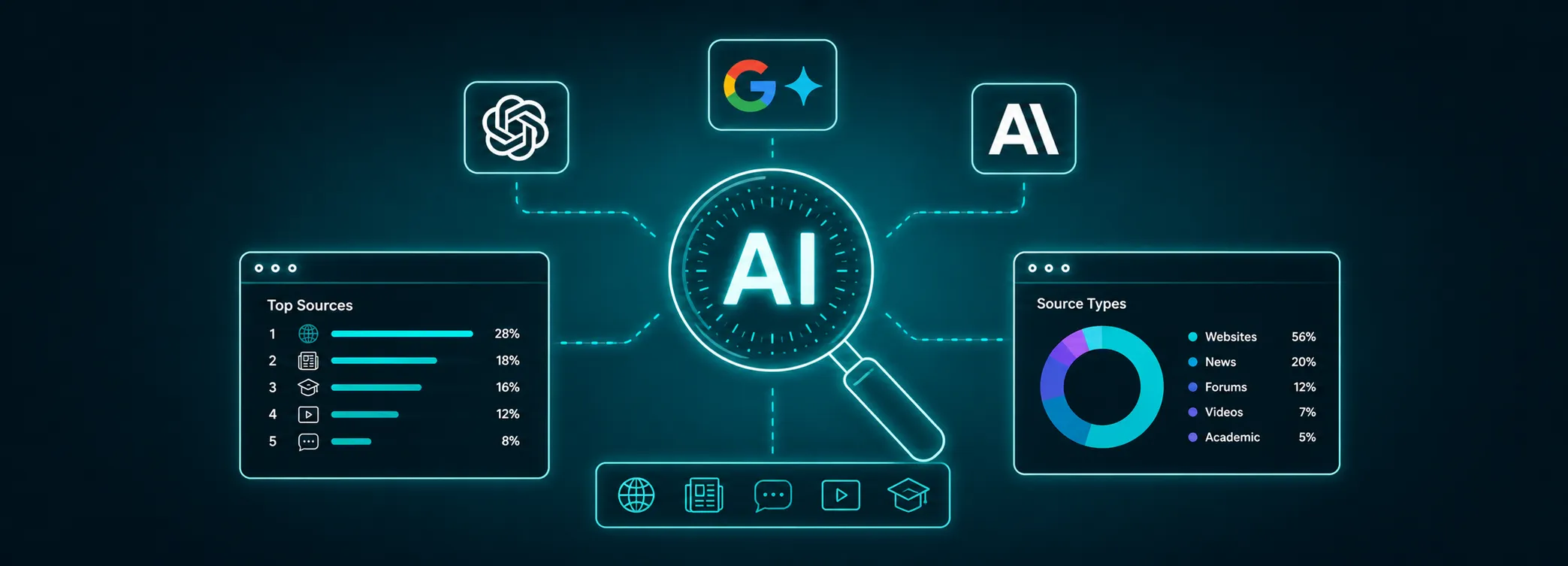
One of the most useful findings in the study is proof that the three models are effectively three independent search engines with almost zero overlap in the sources they prefer to read.
- ChatGPT cites a source in 96% of its answers, with an average of about 5 links per answer. The top domains cited in ChatGPT's answers are Wikipedia, Axios, YouTube, Kiplinger and Forbes.
- Gemini cites sources in around 82% of answers, averaging about 8 sources per answer. Unlike the other two models, Gemini's favorite source is Reddit, followed by YouTube, Quora, Wikipedia and NIH.gov (specifically for the US market).
- Claude turns out to be the most critical, citing sources in only 55% of its answers. But when it does, it really "digs in" on the topic, with an average of about 13 sources per answer - more than twice the number ChatGPT uses. Claude's favorite source is PubMed Central (a free database of scientific research in healthcare), followed by Wikipedia, Quora, ScienceDirect and NerdWallet (again, data dominated by the US market).
A few interesting observations from Muck Rack's research:
- ChatGPT cites sources in almost every answer, though quite briefly.
- Claude relies mostly on the data it was trained on, but when it decides to research online, it does so much more thoroughly.
- Claude never cites Reddit or YouTube in its answers, yet these two sources are among the favorites for Gemini and ChatGPT.
- Wikipedia is a shared source across all three models, but it's cited in a completely different context, industry or user query type for each one.
- AI models cite journalistic content from more than 20,000 sources (both global and local).
The takeaway: Current, diverse and accessible content for your business, across different formats and relevant channels, remains the surest way for your business to get indexed and cited as a source in the answers of popular AI platforms.
The user's question determines what AI reads
AI doesn't treat all questions the same way - the type of query fundamentally changes the list of sources the model chooses, much like Google has, in recent years, learned to recognize whether a search is informational (who are...) or transactional (iphone 17 price), for example, in order to rank search results accordingly.
Here are a few interesting observations that stand out, including for searches in Bulgarian:
- Questions about trends in a given industry ("What are the latest trends in...") most often point AI toward journalistic sources, which it uses in 46% of answers.
- "Who is the best...": This is probably where we caught your attention, because you've already pictured your product or service in the answer. Here, the share of journalistic sources is much lower, because AI models want to help the user make a choice. To do that, they use customer reviews, comparison rankings and recommendations. For queries like this, ChatGPT pulls in Google Maps / Google Business Profile results an average of 188 times per 1,000 questions, recommending an average of 7 businesses per answer. By comparison, Claude almost never uses Google Maps information to give advice.
- "How to..." questions are among the categories with the lowest share of cited journalistic sites. AI relies more on instructions and structured content (guides, checklists and tip lists).
- Questions related to diagnosing a problem ("Why isn't my online store selling?") lead AI toward explanatory content, expert resources and practical guidance before it suggests a solution.
- Comparison queries ("X vs. Y") have the lowest share of journalistic citations of any category. Here, the differences between the three models become especially visible: the same comparison can trigger a check of completely different information sources, depending on whether you ask ChatGPT, Claude or Gemini.
Comment from DGTalents: This breakdown by query type is among the most useful findings in the study for content planning, for almost any business. If you want visibility on trend-related topics (thought leadership, being the voice of the industry, and so on) - invest in PR and commentary on current topics. If you want visibility for "how to" questions - invest in detailed guides, FAQ sections and content that other sources will draw on and that stays relevant for years. Clearly, there's no single tactic that will put you among the top cited sources for every type of query.
Breakdown by industry
The data gets a lot more nuanced when you look at it industry by industry. Among the sectors that benefit most from news-site content are Media & Entertainment, Finance & Insurance, Sports, and Food & Beverage.
On the other end of the ranking, with the lowest share of cited news sources, are organizations in Education, Industrial Manufacturing and Machine Building. For these, AI compensates with academic and research sources, and with the organization's own corporate content on its website and blog.
For the tech sector specifically, the study shows a preference for niche trade publications over mass-market news sites. For example, TechRadar is ChatGPT's top cited domain in this category, ahead of Wikipedia and YouTube.
For Hospitality & Travel, journalistic citations sit around 25-30%, but AI also relies heavily on platforms like TripAdvisor, Expedia and Google Maps, especially for queries like "best hotel" or "best restaurant."
For Healthcare, journalistic citations are lower (around 22%), and AI models lean heavily on specialized directories. As mentioned, PubMed Central is Claude's top source in this category, while Mayo Clinic dominates for ChatGPT.
Not every AI model indexes YouTube content
Video is the preferred content format for users across almost every channel, which makes YouTube one of the platforms with the greatest growth potential. And while its content is becoming an increasingly weighty source for some search engines (even for Perplexity), Claude doesn't cite it in its answers at all. For Gemini, it's the second most important source, while for ChatGPT it ranks third among the most-cited sources.
YouTube content is most often cited in "how to" queries, and the industries that benefit most are those where a product demonstration and its benefits can be shown.
An interesting detail: when AI cites a YouTube video, it often doesn't add any additional sources. The video itself is treated as sufficient evidence for the answer. This means a well-made explainer video could potentially become the only source AI chooses to cite for a given user query.
Newer content may carry more potential
Not enough time has passed since the mass adoption of ChatGPT, Gemini and Claude for us to say definitively how fresher content stacks up against older, established sources. Still, among journalistic citations with a known publish date, around 57% were published within the last 12 months, with the distribution peaking sharply in the first month after publication before gradually tapering off over the following six months. Articles published more than three years ago still make up a noticeable share of citations, but the preference for fresh content is clearly more pronounced.
The takeaway: It's valuable to have a recent media appearance or presence, especially in the case of a PR crisis or heightened information flow around your brand or industry. Otherwise, the models may end up citing outdated, no-longer-relevant content instead.
Citing a source can change the answer itself
By default, AI models rely mostly on the information they were trained on. However, if they're able to scan a source of information online during a search, tests show they can actually change their answer as a result.
What this means for you: make sure every source of information under your control can be accessed and indexed by AI tool bots, to give yourself a better chance of being among the cited answers in a search.
Does the same apply to press releases?
The share of cited press releases in AI answers remains extremely small, and is limited to material with a 100% factual tone. If you put out a press release that leans toward praise or an overblown, subjective tone, it will likely be skipped as a credible source by Claude, ChatGPT or Gemini.
What matters for businesses in the Bulgarian market
Of course, some of the data and statistics mentioned play out somewhat differently in Bulgarian for the local market, but our core recommendations to organizations and our clients remain universally applicable. If greater visibility on AI platforms matters to your business, then:
- Keep developing your blog, but invest in media presence too: What others say about you matters more than what you say about yourself. If we work together, you know our content strategy aims to "earn" your presence in the media, not just arrange a paid placement in a niche or mainstream outlet. Either way, AI will rate published content far more highly if it's genuinely useful rather than merely promotional.
- Structure your content around the type of query you want to "win": If your goal is visibility for industry-trend questions, focus on PR and commentary on current topics. If your goal is visibility for practical questions, invest in detailed, evergreen guides and FAQ sections.
- Don't rely on a single AI model. ChatGPT, Gemini and Claude effectively work from different "libraries" of preferred sources. A strategy optimized only for ChatGPT (through Wikipedia, for example) could leave you invisible on Gemini, which leans more heavily on other sources.
- Keep your content fresh and current. Blog posts, publications, press releases and social media activity all have a direct effect on your AI visibility, and have always carried weight for standard search engine optimization (SEO) too.
- Use video format for practical content and instructions, especially if you're in a sector like consumer goods, retail, energy or manufacturing, where YouTube citations are especially strong.
- Check your site's technical accessibility for AI bots. Being indexed by ChatGPT's, Claude's and Gemini's bots can increase the load on your hosting plan. It's important to make sure your current hosting solution doesn't have limits that could block crawling.
Comment from marketing agency DGTalents
We're able to add to Muck Rack's data thanks to our day-to-day work with companies across different industries - tech, real estate, online stores, transportation companies and more. What they all have in common is that every one of them cares about traffic from AI tools, where users are spending more and more of their time.
We believe well-established SEO practices are an excellent foundation for good visibility on ChatGPT, Gemini and Claude, and we've observed that the traditional "top performers" in this respect are also enjoying the highest AI-tool traffic in the first few months since we've been able to track it.
The Bulgarian market is still far less competitive than the international one, which is a huge opportunity for businesses to achieve greater visibility and authority with much less effort - as long as they invest consistently in content, media presence and technical accessibility for AI bots.
This article is part of our ongoing series on digital marketing and AI visibility. If you want to find out how your brand stands in AI answers, or need a content and SEO strategy built for both Google and AI tools at once, get in touch with the DGTalents team for a consultation. Take a look at our marketing services and projects for more examples of how we work with clients across different industries.
Frequently Asked Questions
What does ChatGPT read before answering a question? ChatGPT cites a source in 96% of its answers, most often Wikipedia, Axios, YouTube, Kiplinger and Forbes, with an average of about 5 sources per answer.
Why does Claude cite less often than ChatGPT and Gemini? Claude relies more on the knowledge it acquired during training and cites sources in only around 55% of its answers. When it does decide to check information online, though, it cites an average of about 13 sources - far more thorough than the other two models.
Which AI model cites the most journalistic sources? All three models - ChatGPT, Claude and Gemini - cite journalism in a combined 20% to 30% of their answers, with the share depending more on the type of question than on the specific model.
How can I increase my brand's visibility in AI answers? Key steps include regular media presence, publishing fresh and factual content, structured guides for practical questions, and technical accessibility of your site for AI bots.
Does it matter whether I write a press release or a blog post? Both formats can be cited, but press releases earn more attention for industry-trend questions, while detailed guides and FAQ sections earn more for practical "how to" questions.
Does Google's AI Mode index differently from classic search? Yes - AI Mode and AI Overviews in Google work on a similar principle of citing trusted, structured sources, which makes GEO and classic SEO increasingly intertwined disciplines. If you'd like to dig deeper into this topic, see our article on Google Ads in AI Mode.
Should I advertise directly on ChatGPT Ads Manager to appear in answers? No - paid advertising and organic citation in AI answers are two separate systems. Paying for ads doesn't increase your chances of being cited organically in response to a user's question. Read more on this in our article on ChatGPT Ads Manager.
Source: Muck Rack, "What Is AI Reading?" Report (May 2026 and June-July 2026 updates), generated by Generative Pulse by Muck Rack, generativepulse.ai/report